Cold flat roof insulation.
Insulating hot cold flat roof.
To produce a hot roof rigid insulation is fitted outside above the weatherproofing.
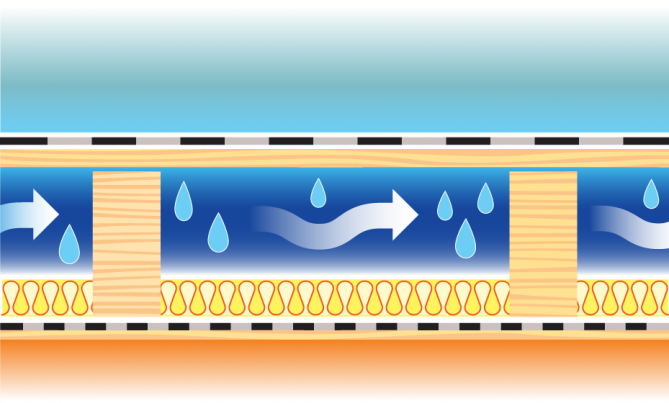
The insulation material is placed between the supporting joists leaving a gap of 50 60mm between the roof and insulation.
Warm deck or warm roof refers to a situation where the deck of the roof which is usually made of wood is below the.
Cold roof systems are highly inadvisable as insulation from the inside will inevitably lead to the formation of condensation.
It is top quality and the most cost effective product for your flat roof.
Flat concrete roofs are generally not ventilated since the ceiling internally is generally a plaster and skim coat directly to the underside of the cold concrete.
For cold flat roofs the vapour layer needs to be positioned underneath the insulation layer on top of the room below to create an effective barrier.
This may help with condensation but causes such a loss of heat that it has been banned in scotland.
Many properties use this option as there are no additional costs for scaffolding or organising how to gain safe access to the roof exterior.
You can expect to pay about 55 100 sq ft.
For a 1 inch board equivalent of 6 r value.
Installing a warm roof can be extremely straight forward and simple to do.
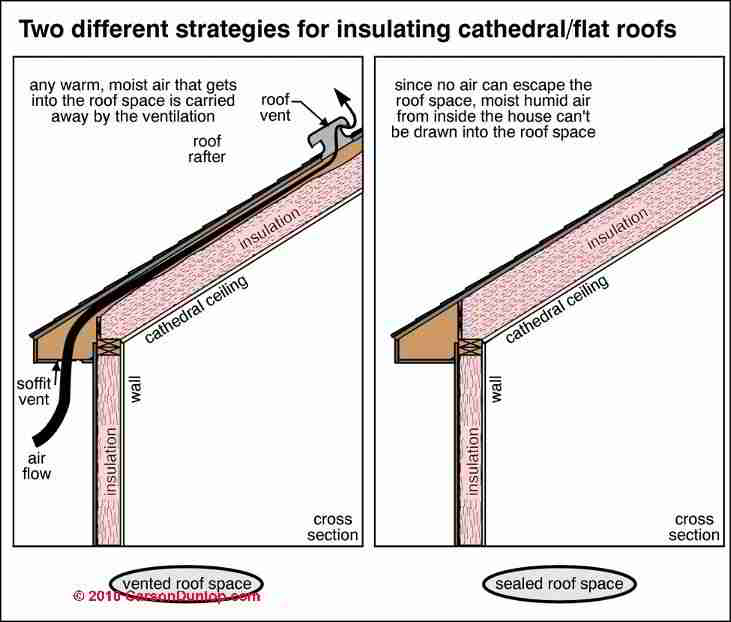
This means there is a vapour control layer in the ceiling and cross ventilation at the eaves or the top of the walls.
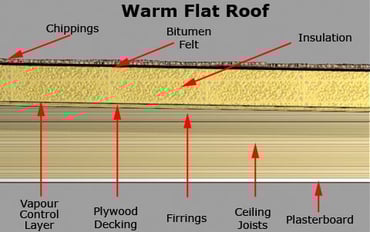
A warm deck roof is where the insulation is placed on top of the rafters joists and the roof covering is then placed over the insulation.
Warm flat roof insulation.
Basically the term cold roof refers to a traditional roof or vented roof while hot roof refers to a roof that is not ventilated and which has foam insulation attached directly to the roof sheathing.
Creating a void between the old ceiling and new is better but ideally you need to eventually consider insulating the top of the concrete roof with solid insulation and a better covering grp or epdm.
On a warm flat roof the layer is installed underneath the insulation to stop moisture interacting with it through rising thermal pressure lower down in the building.
No ventilation is required for these types of roofs.
While expensive the best insulation is polyiso rigid foam.
Warm roofs offer a superior thermal performance and therefore come with a higher cost.
This is then covered with a further weatherproofing layer.
This will enable the airflow to circulate freely.
Basically there are two options to choose from when insulating a flat roof.
With a warm roof the insulation is installed on top of the existing surface rather than in between the rafters.
There are three types of insulation solution if you have a flat roof.